The Essentials: The Nicene Creed
Created for Discovery Church, 2025, by Beth Longtine, Latex, Raw canvas, 27”x 51” (each)
Text written by Zach Kreeger, Pastor at Discovery Church
This project has been inspired by centuries of church tradition that spans iconography to stained glass. The deep desire is that in our auditorium, even the walls would speak of the goodness of God. But where do you begin? Over the course of several conversations, we realized we didn’t just want to pick our favorite Bible stories but truly wanted each piece to reflect a fundamental element of the story of God: the most essential parts.
As a church that adheres to the Nicene Creed, it seemed a great place from which to draw inspiration. Each of the pieces below draws on subsequent lines of that creed, ultimately telling the story of the gospel from before there was creation, to a time we call ‘eternity.’ In the lower corner of each piece is also an image meant to simplify the meaning of the image and link all the pieces together. We know that the gift of art is a limited medium by which to understand God, but even so, is still a way we can see more of him!
Trinity
The Celtic Knot was an attempt to understand both the ‘One’ and the ‘Three’ nature of God. While a singular line, it reflects three distinct and intertwined parts. We wanted to engage a similar idea, but turn it into more of a relational image in a three dimensional shape. This image of community reflects the three distinct, yet fully interrelated character of a God with one essence. Varied roles are noticeable in the crown of the father, the sash of the Son (which will show up in later images), and the fire of the Spirit (also in later images). Their interlocked and even indistinguishable arms represent a dance and an embrace which both have space enough to invite us to join God in both.
CORNER SYMBOL: The celtic knot is distinct and set apart from all other elements. The Trinity remains a story to itself outside of time and space unlike any other of the pieces.
Creation
This image borrows from Leonardo DaVinci’s drawing of ‘The Vitruvian Man” - a single man inscribed in a circle and a square, symbolizing the ideal proportions of the human body according to ancient Roman architect Vitruvius. However, Genesis 1:27 makes clear that, “God created mankind in his own image, in the image of God he created them; male and female he created them.” The image of God is put on fullest display in the realization of both human genders and offers them both the world in which to rule and have dominion. The triangle behind them harkens back to the image of the Trinity which not only measures them but is the original ‘image’ behind their design. All of this design fits neatly inside the blue circle: a symbol for God’s perfect order and completed work.
CORNER SYMBOL: This full, flourishing tree reflects a perfect design of things as they were intended to be.
The Fall
God told Adam and Eve not to eat from the Tree of the Knowledge of Good and Evil. Whereas the act of creation had created a natural ‘order’ to the world (fit perfectly inside the circle of blue) this tree - and the choices of Adam and Eve - have suddenly grown outside of the desire of God. The life of perfect relationship to God and each other… the life of stewarding creation in harmony and dominion… was suddenly replaced with a curse and pain. Evil is no longer within this tree but has infected all aspects of the created order. Death has crept into the picture. However, this tree is bent, and not broken; dying but not dead. It is in need of healing. The branch that is bent symbolically reflects the entire tree: it is not totally lost but is certainly in need of repair. While it has gone beyond God’s design, it has not gone beyond God’s power. However, without the intervention of God, it is certainly lost.
CORNER SYMBOL: Anything that has fallen totally away from the circle of God’s presence is certainly dead. It is only the presence of God that hope can possibly be maintained.
Immanuel
Immanuel means ‘God with us.’ It was one of the names given to the incarnated God, Jesus the Messiah. In this image, you may wonder at the idea of two parents holding a newborn infant. The fragility and smallness of this baby are intentional. The largeness of the Father’s hands surround not just human hands, but the image of the entire world. Jesus certainly came for humanity, but we understand his saving work to be done with a vision for redeeming all of creation.
CORNER SYMBOL: The manger is literally the location of the birth of Jesus, but poetically also serves as a symbol that is both God made (the tree/wood) and man made (crafted into a manger).
Holy Spirit
To be clear, the Holy Spirit is absolutely a person, however, unlike Jesus Christ, it is a character who does not take human form. How then do you capture what this personality ‘is’ and ‘does?’ In Ezekiel 36:26, God promises “I will give you a new heart and put a new spirit in you; I will remove from you your heart of stone and give you a heart of flesh.” Similarly, in John 7:37-39 Jesus said “Let anyone who is thirsty come to me and drink. Whoever believes in me, as Scripture has said, rivers of living water will flow from within them.” By this he meant the Spirit,whom those who believed in him were later to receive. Up to that time the Spirit had not been given, since Jesus had not yet been glorified. This image reflects both the partnership and agency of the Holy Spirit in the life of a believer. There is a process to the work happening here. You’ll notice at the edges of the heart chunks of stone being broken off to reveal the true heart. You’ll notice the veins of Spirit breaking apart the stone and bringing the heart to life. This is a picture not simply of healing, but of bringing to life something dead. It’s a journey, and while heaven will be the finishing touch, the life of a follower of Jesus is a litany of encounters with the spirit of breaking off pieces of our false selves over time to reveal more of our true selves.
CORNER SYMBOL: Movement of spirit… the importance of ‘wind’... draws us both to OT image and to Pentecost…
Prophets
God clearly did not intend to give up on his creation in the fall. We immediately see God continuing his relationship with Adam and Eve, talking with them, providing them clothes, and despite ushering them from the garden, continued to interact with them and their children. As the story of the Old Testament unfurled, we see the images of both the temple and the prophets emerge as God’s invitation to his people to return to the garden and the relationship they were made for. The prophets in this image take on the form of the columns of the temple in Jerusalem. The temple pillars simply held up the roof… creating the space for the worship of God… establishing the location of truth and beauty and goodness. The bowl of fire reflects the message they carry and reminds us that we may not enter the presence of God without an offering of atonement and a cleansing. The prophets offer an opportunity to repent and reveal what is false in order to enter back into truth. Their crowns reflect their royal role in their service as messengers of the most Holy. Unlike the picture of the fall where we see the tree breaking out of the desires of God (the circle around the tree), we see these columns opening up a doorway back into that desire. It is with this sense that we understand prophets not merely as the select few names we see at the end of the Old Testament, but rather, any person speaking truth and being called by God to make space for worship and relationship with their very lives. It is a living temple, to be sure! Its location is not just in an individual, but as the book of Hebrews 12:1 labels them, ‘a great cloud of witnesses.’
CORNER SYMBOL: This symbol harkens back to the burning bush as a picture of the prophet Moses and a reminder that the fire of God which is given to his prophets burns but does not consume. It calls his people home, but does not seek to destroy them.
Crucifixion
This modernized image borrows from the painting ‘Agnus Dei’ (Lamb of God), painted in the 1600’s by the Spanish painter, Francisco de Zurbarán. This passover lamb draws on one of the Bible’s most important stories: the Exodus. It was through the blood of an unblemished lamb on the doorposts of their homes that the Hebrews were finally liberated from their captivity and could begin their Journey with God back to their homeland. The blue circle perfectly covers this image as a reminder of Philippians 2:6-8 which tells us that though Jesus was God, “being in very nature God, did not consider equality with God something to be used to his own advantage; rather, he made himself nothing by taking the very nature of a servant, being made in human likeness. And being found in appearance as a man, he humbled himself by becoming obedient to death—even death on a cross!” This lamb is not struggling against its bonds but has fully submitted to the will of God. Similar to the painting of Creation, the perfect order of God’s design is restored in this image. The horns on the corner of the altar are not only reflective of the actual design of the altar in the temple (Exodus 27:2), but also remind us that the sacrifices offered here created a space of refuge and asylum for any fugitive who would hold on to them (1 Kings 1:50).
CORNER SYMBOL: The flourishing tree being intentionally cut down… completely killed… creates a moment of horror and grief at the loss of true life…
Resurrection
The image of the Trinity recognizes the character of the son being distinguished by his blue sash. Here, we see his sash, as his burial cloths, hung upon the cross as if he is saying, “I did what I was supposed to do: I fulfilled my mission.” As Beth likes to say, “It’s a bit of a mic-drop moment for Jesus.” The horror of the cross is made beautiful in its emptiness. The sign hung above as an intended insult now announces an eternal truth (INRI is a latin abbreviation for “Jesus of Nazareth King of the Jews”). The Three circles behind the cross again point back to the trinity as if to say that each moment of this story has been orchestrated by the Trinity of God and that God has worked in unison to accomplish this redeeming work. Since the dawn of time, this has always been the plan and that God is in the business of restoring what has been lost.
CORNER SYMBOL: Here we see the tree outside the empty tomb standing as a witness. It’s as if to say, “if that tree could talk… if nature could speak as a witness… the rocks would cry out (Luke 19:40)!
Ascension
This character of the Trinity, feet willingly in the dirt of our world, extends his hands back to heaven in the same way as a child readies itself to be picked up by his Father - fully holding hands again with him as in that first image. This fully alive and restored man prepares to be restored to his rightful place: at the right hand of the Father. The blue behind him simply represents the sky we see Jesus ascending into in Acts 1:11. It is paramount to understand that the body, not simply the Spirit, of Jesus ascended. A physical Jesus reigns in heaven and earth with ears that hear and a mouth that speaks as he advocates for humanity with the Father. It will be this physical Jesus that comes back with a physical new earth at the end (and beginning) of all things.
CORNER SYMBOL: The root of Jesse is growing a seemingly dead branch not only representing the crucifixion of Jesus, but also the fall of humankind. Life springs from death.
Church
When God instructed the building of the temple, great importance was given to the lamps and candles that would light the room. They not only helped attendants to see but metaphorically spoke to Genesis 1 where light and darkness were separated, order was brought to chaos, and the truth and beauty of God cast out the dark. Jesus would go on to say that “You are the light of the world… put it on its stand and it gives light to everyone (Matt 5:14-15)” offering the surprising invitation to be bearers of God’s order, beauty, and truth. You’ll notice that each candle in this image has a face representing individuals held together in community representing the church. Further, the fire above their heads reflects the day of pentecost when tongues of fire rested on the apostles as an image that the Holy Spirit was no longer being located in the temple, but in the children of God - the church! These people are called the “Light of the World”, showing all people the glory of God through our love for one another.
CORNER SYMBOL: Jesus said I am the vine, you are the branches. The church reflects the abiding of his people with their savior. Their role is to abide, the product of which is that they bear fruit.
Baptism
The arms of this character are crossed in much the same way as someone being baptized would be crossed. Beyond the practical reason for this, this posture also reflects a surrender and trust in the person baptizing them. This baptism is not something done under the strength of the individual, but rather in total surrender to the strength of another to save them. This particular image was intended to look like a cauldron holding fire. The white flames remind us of the holy fire of God that purifies us like precious metal, allowing the dross to be scraped off the top. Likewise, the heart is being washed clean by the water. You may notice that the heart remains green in this process which is simply a reminder that baptism is not a ‘finishing’ work but rather a public declaration that one is beginning the journey of sanctification as their heart will daily be cleansed again and again in a repetitive act of choosing to die to self and come alive to God - the fundamental idea of baptism.
CORNER SYMBOL: A branch is being grafted in. If it were not grafted, it would most certainly die on its own. By being grafted, this branch has undergone a cutting, a bleeding, and an exposure that every human being experiences. However, because it has been grafted, this branch now knows something beyond its suffering. It is now offered not only life, but the ability to produce fruit.
New Creation
"As the new heavens and the new earth that I make will endure before me, declares the LORD, so will your name and descendants endure (Isaiah 66:22).” This image points back to the initial image of creation, however, just as you cannot put new wine in old wineskins, only this new earth can handle the fullness of the kingdom of God. In this new earth, it will swell, sweeten, and mature. This earth is still the earth, however, it has been made entirely new and is entirely free of evil. The image looks like a wine glass which reminds us of the wedding feast of the Lamb which is referenced throughout scripture but perhaps captures best in Revelation 19:9. The glass also reflects the image of the third cup of passover: the cup that Jesus lifted up at the last supper and said, “This cup is the new covenant in my blood.” The covenant of this cup is fulfilled in this new creation! The stem of this wine glass equally reflects the overflow of God’s lavishness. The white circle represents the perfect presence of the Trinity now again in perfect harmony with creation.
CORNER SYMBOL: This full forest image reminds us that the story was not simply to ‘return’ to the garden of Eden, but that this story has somehow done something ‘more’ than when it began. The final image of the new creation is a city with people who are clothed in white.
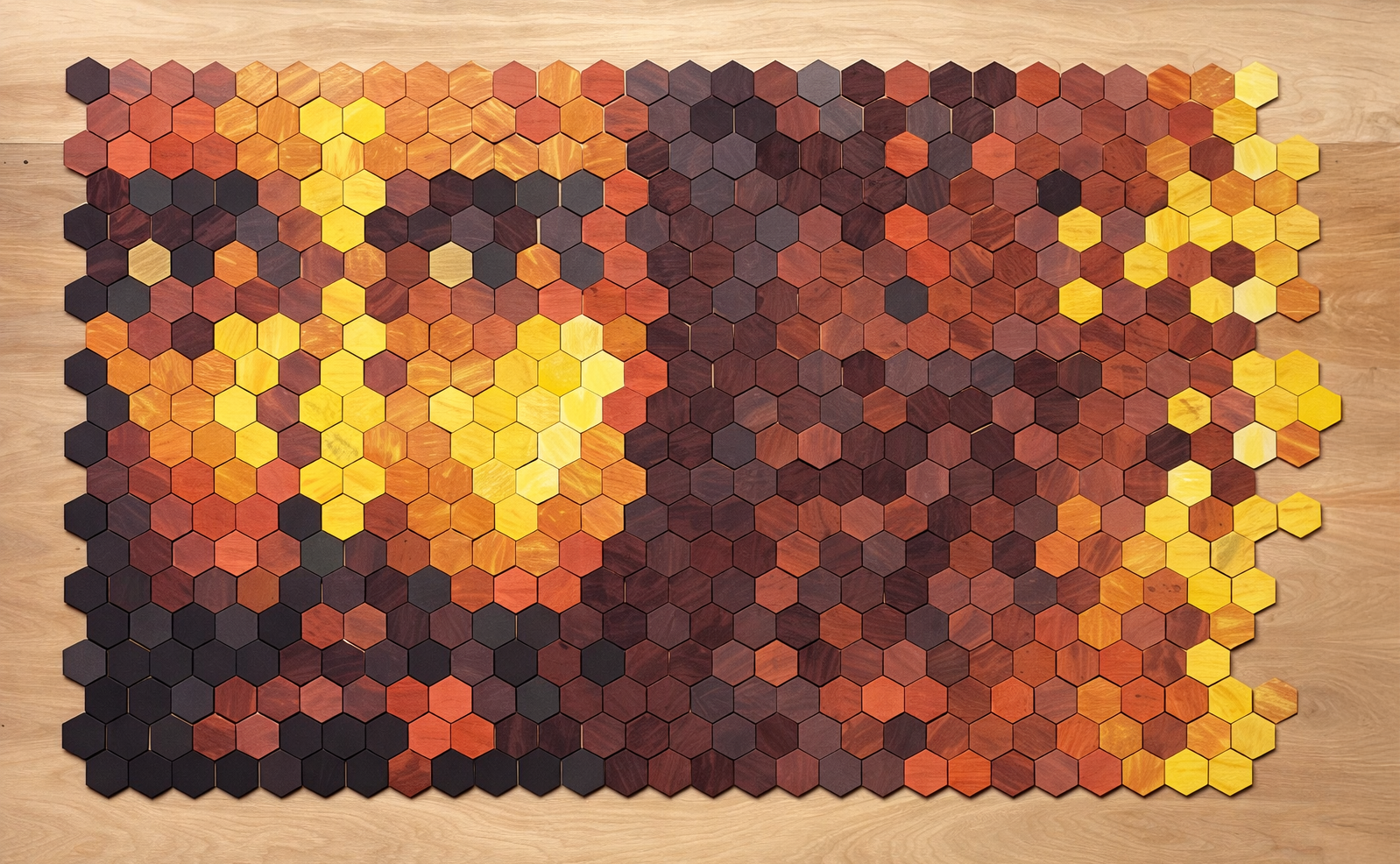
Emerging Messiah
Created for Discovery Church, 2022, by Beth Longtine, Wood Mosaic, Acrylics, 96”x48”
An interactive piece correlating with a sermon series on the emerging awareness of Jesus’ divinity during his lifetime.